
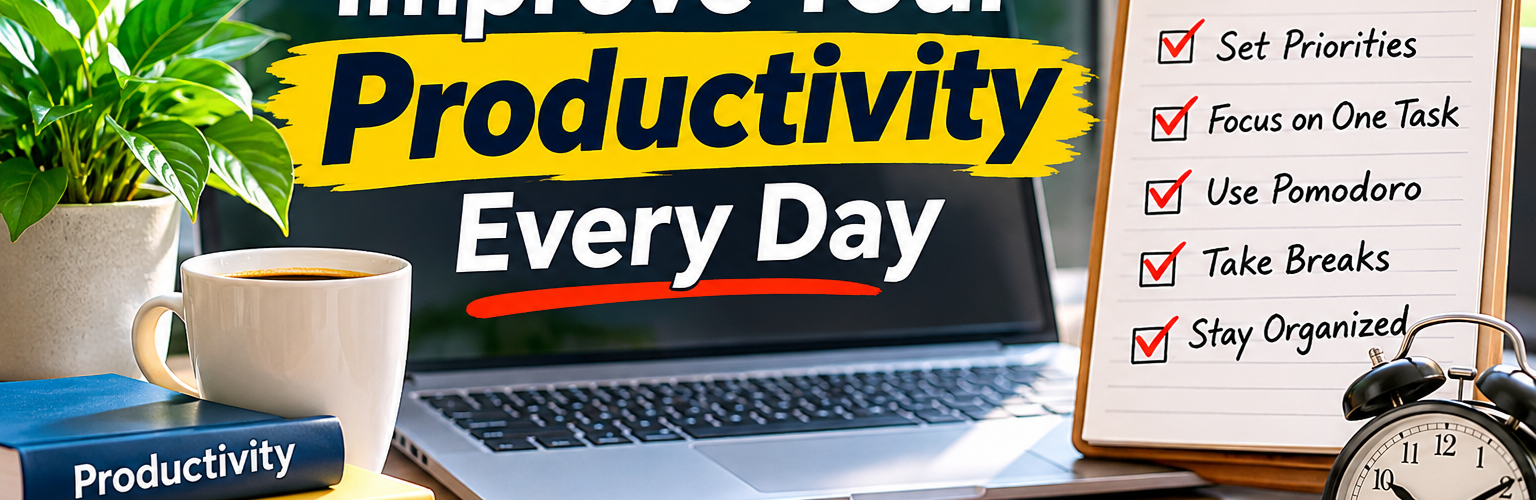
Productivity isn’t about working longer hours or keeping yourself busy from morning until night. It’s about using your time wisely, focusing on what matters, and developing habits that help you accomplish your goals without feeling overwhelmed.
Whether you’re a student, employee, entrepreneur, or someone managing a busy household, improving your daily productivity can make your responsibilities easier to manage.
The good news is that you don’t need an expensive computer, complicated software, or a complete lifestyle change to get started. Small improvements in how you organize your day can make your work more manageable.
In this guide, you’ll discover 10 practical daily productivity tips that you can start using immediately to organize your schedule, reduce distractions, improve your focus, and make better use of your time.
1. Start Your Day with a Clear Plan
Starting your day without knowing what you need to accomplish can make it difficult to decide where to begin. Instead of reacting to every new request or interruption, take a few minutes to establish your priorities.
A simple daily plan gives you a starting point and helps you organize your responsibilities.
How to put this into practice:
- Write down everything you need to accomplish.
- Identify the three most important tasks.
- Estimate how much time each task might require.
- Schedule your most important work during a suitable time of day.
- Leave some flexibility for unexpected responsibilities.
For example, if you have a report to complete, emails to answer, and several personal errands, decide which responsibility deserves your attention first.
You don’t need to create a complicated schedule. A notebook, calendar, or simple digital checklist is enough.
Practical tip: Prepare your daily task list before starting work. Having a clear starting point can make it easier to take action instead of spending valuable time deciding what to do.
2. Prioritize Important Tasks with the Eisenhower Matrix
One common productivity challenge is treating every task as equally important. Answering emails, attending meetings, completing assignments, and handling urgent requests can quickly fill your schedule.
The Eisenhower Matrix offers a straightforward way to organize tasks according to their urgency and importance.
It divides responsibilities into four categories:
Urgent and Important — Do It Now
These tasks require immediate attention and have significant consequences if delayed. Examples include meeting an important deadline or resolving a serious work problem.
Important but Not Urgent — Schedule It
These activities contribute to your longer-term goals. Examples include learning a new skill, planning a business project, exercising, or preparing for an upcoming examination.
Urgent but Not Important — Delegate It
These tasks may require attention but don’t necessarily need to be completed by you. When possible, delegate them or find a more efficient way to handle them.
Neither Urgent nor Important — Eliminate It
These activities consume time without contributing meaningfully to your priorities. Examples might include unnecessary browsing or repeatedly checking social media.
Practical tip: Review your task list every morning and place each responsibility into the appropriate category. Start with important tasks instead of allowing less important activities to control your schedule.
3. Use the Pomodoro Technique to Maintain Focus
Working on a demanding task for several hours without a break can become difficult. The Pomodoro Technique provides a simple structure for organizing focused work sessions.
The traditional method uses 25-minute work intervals followed by five-minute breaks.
Here’s how to use it:
- Choose one task you want to complete.
- Set a timer for 25 minutes.
- Work on that task without unnecessary interruptions.
- When the timer rings, take a five-minute break.
- Repeat the process.
- After four work sessions, take a longer break.
For example, if you’re writing an article, dedicate one session to researching your topic, another to writing the introduction, and another to developing the main sections.
You can use a kitchen timer, smartphone, or free online timer.
The technique doesn’t have to follow exactly 25 minutes. If your work requires longer periods of concentration, experiment with different intervals.
Practical tip: During each work session, focus on one specific responsibility. Avoid switching between emails, social media, and unrelated tasks.
4. Organize Your Workspace to Reduce Distractions
Your workspace can influence how easily you approach your daily responsibilities. A desk covered with unnecessary objects, scattered documents, and unrelated items can make it harder to locate what you need.
Creating an organized environment gives you a more convenient place to work.
Start with these simple steps:
- Remove unnecessary objects from your desk.
- Keep frequently used supplies within reach.
- Organize important documents into folders.
- Put away items that don’t belong in your workspace.
- Clean your computer desktop and organize digital files.
You can also create separate areas for different activities. For example, keep your computer and work documents together while placing personal items somewhere else.
Don’t attempt to organize everything in one afternoon. Start with your immediate workspace and gradually improve the surrounding environment.
Practical tip: Spend the final 10 minutes of your workday organizing your desk. This gives you a cleaner starting point the following morning.
5. Set SMART Goals Instead of Vague Objectives
Having goals gives your daily activities a direction. However, vague objectives can make it difficult to determine what progress actually looks like.
For example, saying “I want to improve my productivity” doesn’t explain what you need to accomplish.
SMART goals provide a more structured approach.
SMART stands for:
- Specific: Clearly identify what you want to achieve.
- Measurable: Decide how you will track your progress.
- Achievable: Choose a goal that is realistic.
- Relevant: Make sure the goal supports your priorities.
- Time-bound: Establish a deadline.
Consider this example:
Instead of saying, “I want to learn something new,” create a goal such as:
“I will complete three online lessons about digital marketing by Friday.”
The second objective gives you a clear task and a deadline.
You can apply this approach to professional development, education, personal projects, and business activities.
Practical tip: Write down one important weekly goal and divide it into smaller daily tasks. Completing those smaller steps can help you maintain momentum.
6. Focus on One Task at a Time
Trying to handle several responsibilities simultaneously can make your day feel unnecessarily complicated.
You might answer an email while preparing a report, respond to phone notifications, and attempt to participate in a meeting. Before long, your attention is divided between several activities.
Instead, practice single-tasking.
Single-tasking means giving your attention to one responsibility before moving to another.
Here’s how to get started:
- Choose the task that deserves your attention.
- Put your phone away or silence unnecessary notifications.
- Close unrelated browser tabs and applications.
- Work until you finish the task or reach a planned stopping point.
- Review your progress before moving to the next responsibility.
For example, if you’re preparing a presentation, concentrate on completing the presentation before opening unrelated projects.
You don’t have to finish every task in one sitting. The objective is to avoid unnecessary switching between unrelated activities.
Practical tip: Create a short list of tasks and work through them in priority order rather than constantly jumping between different responsibilities.
7. Use Productivity Tools to Stay Organized
Technology can help simplify your daily routine when you choose tools that solve actual problems.
You don’t need dozens of applications. Start with a few tools that make it easier to organize tasks, manage information, and remember important deadlines.
Here are some options:
Task Management
- Todoist: Organize tasks and create projects.
- Trello: Manage projects using boards and cards.
- Microsoft To Do: Create personal task lists.
Note-Taking
- OneNote: Organize notes and information.
- Notion: Create notes, databases, and personal workspaces.
- Evernote: Capture and organize information.
Calendar Management
- Google Calendar: Schedule appointments and activities.
- Microsoft Outlook Calendar: Organize meetings and events.
Focus and Time Management
- Forest: Use focused sessions to encourage reduced phone distractions.
- Freedom: Manage access to distracting websites and applications.
The best tool depends on your needs and working habits.
For example, a student might prefer a calendar and a note-taking application, while a small business owner might benefit from a project management platform.
Practical tip: Choose one or two applications and learn how to use them properly before adding more. Too many tools can make your organizational system unnecessarily complicated.
8. Take Regular Breaks to Maintain Your Energy
Productivity doesn’t mean staying at your desk every minute of the day.
Planning short breaks gives you an opportunity to step away from your responsibilities and return with a fresh perspective.
You can incorporate simple activities into your breaks:
- Stand up and stretch.
- Take a short walk.
- Drink a glass of water.
- Step away from your computer screen.
- Get some fresh air.
- Relax for a few minutes without checking notifications.
You can also schedule a longer lunch break rather than eating while continuing to work.
The important thing is to make your breaks intentional. Spending your entire break scrolling through social media may not give you the change of activity you’re looking for.
Practical tip: Add breaks to your daily schedule just as you would add important appointments. This makes it easier to avoid filling every available minute with work.
9. Prepare Your Schedule the Night Before
A productive morning can begin with a little preparation the previous evening.
Instead of waking up and immediately trying to figure out everything you need to do, take a few minutes to organize your responsibilities.
Consider following this simple evening routine:
- Review your unfinished tasks.
- Check your calendar for upcoming appointments.
- Choose your three main priorities for tomorrow.
- Prepare any documents or materials you’ll need.
- Organize your workspace.
- Write down anything important that you don’t want to forget.
For example, if you have an important meeting the following morning, prepare your notes and documents the night before.
If you’re studying, organize your books and identify the lesson you plan to complete.
This approach gives you a clearer starting point when the next day begins.
Practical tip: Spend 10 to 15 minutes reviewing your plans before ending your day. Keep your schedule realistic and avoid filling it with more responsibilities than you can reasonably manage.
10. Build Consistent Daily Habits
The final productivity tip is to focus on consistency.
You can discover many useful productivity methods, but constantly changing your routine makes it difficult to establish a system that works.
Instead of trying to change everything at once, introduce small habits that support your daily responsibilities.
Here are a few examples:
- Review your priorities every morning.
- Keep your workspace organized.
- Complete your most important task before moving to less important activities.
- Schedule time for learning and personal development.
- Review your progress at the end of each day.
- Prepare your schedule for tomorrow.
Start with one habit and practice it consistently before introducing another.
You can also use a simple habit tracker to record your progress. Mark each day you complete your chosen activity and review your results at the end of the week.
Remember that missing a day doesn’t mean you have failed. Return to your routine and continue working toward your goals.
Practical tip: Choose one productivity habit you can realistically maintain for the next seven days. Once it becomes part of your routine, consider adding another.
Conclusion: Make Every Day More Productive
Improving your productivity doesn’t require a complicated system or a complete change in your lifestyle.
Start by organizing your responsibilities, identifying your priorities, reducing unnecessary distractions, and creating a daily routine that works for your needs.
You don’t need to implement all ten strategies immediately. Choose two or three ideas from this guide and begin applying them today.
For example, you could start by preparing your schedule the night before, using the Pomodoro Technique during focused work sessions, and organizing your workspace.
As you discover which methods work best, gradually build a routine that supports your personal and professional goals.
The objective isn’t simply to do more tasks. It’s to spend your time on activities that genuinely matter.
Start small, stay consistent, and make each day count.
Frequently Asked Questions (FAQs)
1. What are the best daily productivity tips for beginners?
Start by writing a daily task list, identifying your three most important priorities, organizing your workspace, and limiting unnecessary distractions. These simple practices provide a starting point for building a more organized routine.
2. How can I become more productive without working longer hours?
Focus on prioritizing important responsibilities, reducing interruptions, and organizing your schedule. You can also divide larger projects into smaller tasks and schedule dedicated time to complete them.
3. What is the Pomodoro Technique?
The Pomodoro Technique is a time management method that traditionally uses 25-minute focused work sessions followed by five-minute breaks. After four sessions, you take a longer break.
4. Which productivity apps should I use?
Popular options include Todoist and Microsoft To Do for task management, Google Calendar for scheduling, and OneNote or Notion for organizing information. Choose applications based on your actual needs.
5. How can I stay productive when I feel overwhelmed?
Start by writing down everything that needs your attention. Separate urgent responsibilities from less important activities, choose one manageable task, and work through your priorities gradually.
6. How do I maintain a productive daily routine?
Create a realistic schedule, establish a few consistent habits, review your progress regularly, and adjust your routine when necessary. Focus on consistency rather than perfection.
7. Why is planning the night before useful?
Planning ahead gives you an opportunity to review your responsibilities, identify priorities, and prepare the materials you need for the next day.
